Workshop on AI and Economics
Took place 16–20 March 2026
International Centre for Mathematical Sciences

Took place 16–20 March 2026
International Centre for Mathematical Sciences
Keynote talks were recorded by ICMS. The full set is on the ICMS YouTube playlist.

Kosuke Imai · Harvard
GenAI Powered Inference
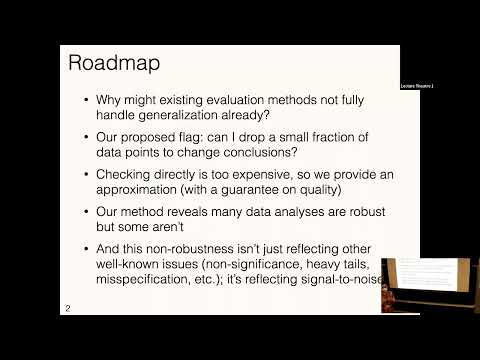
Tamara Broderick · MIT
An Automatic Finite-Sample Robustness Check: Can Dropping a Little Data Change Conclusions?

Annie Liang · Northwestern
Using Machine Learning to Generate, Clarify, and Improve Economic Models

Stephen Hansen · UCL
Policymakers' Uncertainty
All times are Greenwich Mean Time (GMT).
| Mon 16 | Tue 17 | Wed 18 | Thu 19 | Fri 20 | |
|---|---|---|---|---|---|
| Morning | Keynote + talks | Keynote + talks | Keynote + talks, form groups | Keynote + talks, group work | Keynote, group presentations |
| Afternoon | Talks | Talks | Excursion | Group work | Packed lunch & end (~12:45) |
| Evening | Dinner (self-organized) | Dinner (self-organized) | Dinner (self-organized) + Ceilidh | Dinner (self-organized) | — |
| Time | Event |
|---|---|
| 09:15–09:30 | Housekeeping by ICMS / Introduction by organizers |
| 09:30–10:15 | Keynote: Kosuke Imai, Harvard University — GenAI Powered Inference [video] |
| 10:15–10:45 | Coffee Break |
| 10:45–11:00 | Sukjin Han, U. Bristol — Can LLMs Predict Human Behavior? A Measure of their Pretrained Knowledges |
| 11:00–11:15 | Yucheng Yang, U. Zurich — Structural Reinforcement Learning for Heterogeneous Agent Macroeconomics |
| 11:15–11:30 | Peter Lambert, LSE & Warwick — AI-Derived Economic Structures: From Networked Data to Macro-Calibrations |
| 11:30–12:00 | Coffee Break |
| 12:00–12:15 | Giuseppe Matera, EPFL — Corporate Earnings Calls and Analyst Beliefs |
| 12:15–12:30 | Simone Daniotti, Utrecht University — GenAI for Measurement, Autonomy, and Understanding |
| 12:30–12:45 | Aldo Glielmo, Bank of Italy — Heterogeneous RBCs via deep multi-agent reinforcement learning: unifying macroeconomic modelling through computation |
| 12:45–14:00 | Lunch |
| 14:00–14:15 | Alyssa Rusonik, HEC Paris — The evolving credibility of stories |
| 14:15–14:30 | Adam Brzezinski, LSE — Narrative Entanglement in Climate Policy |
| 14:30–14:45 | Johanna Einsiedler, U. Basel — Assessing the potential for automated article coding and data extraction in the social sciences |
| 14:45–15:15 | Coffee Break |
| 15:15–15:30 | Pablo Astudillo, USFQ — Unveiling Economic Dark Matter: Detecting Informal and Illicit Economic Activities Through Graph Neural Networks |
| 15:30–15:45 | Ole Teutloff, U. Oxford — AI reconfigures international outsourcing: Evidence from online freelancing |
| Time | Event |
|---|---|
| 09:30–10:15 | Keynote: Tamara Broderick, MIT — An Automatic Finite-Sample Robustness Check: Can Dropping a Little Data Change Conclusions? [slides] [video] |
| 10:15–10:45 | Coffee Break |
| 10:45–11:00 | Flore Sentenac, HEC Paris — The Challengers: When Does New Data Justify Switching Machine Learning Models? |
| 11:00–11:15 | Alireza Amanihamedani, London Business School — Near-optimal Adaptive Policies for Dynamic Matching Markets |
| 11:15–11:30 | Asher Lawson, INSEAD — Designing behavioural interventions with explainable AI |
| 11:30–12:00 | Coffee Break |
| 12:00–12:15 | Francesca Larosa, KTH Royal Institute of Technology — Not artificial, but very intelligent: the environmental appetite of AI investments |
| 12:15–12:45 | Coffee Break |
| 12:45–14:00 | Lunch |
| 14:00–14:15 | Marta Grzeskiewicz, U. Cambridge — Neural Demand Estimation with Habit Formation and Rationality Constraints |
| 14:15–14:30 | Greg Levy, U. Oxford — Stable and Sparse: Formalising and Optimising Interpretability for High-Dimensional Estimation |
| 14:30–15:00 | Coffee Break |
| 15:00–15:15 | Lorenzo Tortora, CREF — GitHub repositories predict which professions will be impacted in the future |
| 15:15–15:30 | Massimiliano Furlan, U. Warwick — Deep Learning Across Games |
| 15:30–15:45 | Rahul Savani, U. Liverpool + Ted Turocy, U. East Anglia — Automated Analysis of Strategic Interactions |
| Time | Event |
|---|---|
| 09:30–10:15 | Keynote: Luke Marris, Google DeepMind — TBC |
| 10:15–10:45 | Coffee Break |
| 10:45–11:00 | Ben Weidmann, UCL — Measuring Leadership Skills using Artificially Intelligent Agents |
| 11:00–11:15 | Anton Pichler, Vienna U. of Economics and Business — A data-driven agent-based model of the North American gas sector |
| 11:15–11:30 | Elizabeth Rhodes, OpenResearch — Reimagining Survey Research: AI-Powered Conversational Methods for Capturing Economic Complexity |
| 11:30–12:00 | Coffee Break |
| 12:00–12:45 | Forming working groups |
| 12:45–14:00 | Lunch |
| 14:00–16:00 | Excursion (Arthur's Seat) |
| 19:00–21:00 | Dinner (self-organized) |
| 21:30–23:30 | Ceilidh at Stramash, Cowgate |
| Time | Event |
|---|---|
| 09:30–10:15 | Group work |
| 10:15–10:45 | Coffee Break |
| 10:45–11:00 | Nida Jamil, U. Limerick — Asymmetrical Algorithmic Pricing Frequencies and Market Power: A Q-learning Approach |
| 11:00–11:15 | Daria Godorozha, LSE + Sam Inman-Altass, LSE — Reinforcement Learning-Driven Development of Utility-Maximization Functions for Rational Agents |
| 11:15–11:45 | Coffee Break |
| 11:45–12:45 | Group work |
| 12:45–14:00 | Lunch |
| 14:00–14:45 | Keynote: Annie Liang, Northwestern University — Using Machine Learning to Generate, Clarify, and Improve Economic Models [video] |
| 14:45–15:15 | Coffee Break |
| 15:15–16:00 | Group work |
| Time | Event |
|---|---|
| 09:30–10:15 | Keynote: Stephen Hansen, UCL — Policymakers' Uncertainty [video] |
| 10:15–10:45 | Coffee Break |
| 10:45–11:30 | Group presentations |
| 11:30–12:00 | Coffee Break |
| 12:00–12:45 | Group presentations |
| 12:45 | Packed lunch and end |
This workshop brought together economists, computer scientists, and data scientists to explore how AI and machine learning are reshaping economic research. Topics spanned generative AI for statistical inference, reinforcement learning for macroeconomic modelling, deep learning for game-theoretic analysis, neural approaches to demand estimation, AI-powered survey methods, narrative analysis of policy discourse, the labour-market effects of AI, and algorithmic pricing. Beyond talks, participants collaborated in small groups to develop new research ideas at the intersection of AI and economics.
This was a workshop, not a conference: we set aside time for participants to actually work together on new ideas, not just present at each other.
Lunches and coffee breaks were provided throughout the week.
Practical info from the workshop, kept here for reference.
Bayes Centre, 47 Potterrow, Edinburgh EH8 9BT
ICMS is on Level 5.
See the ICMS workshop page for further details.
Edinburgh's city center is compact and most things are within easy walking distance of the venue. Taxis and rideshares (Uber, Bolt) are readily available if needed.
From April 2025, all visitors to the UK who do not need a visa for short stays and who do not already have UK immigration status must obtain an Electronic Travel Authorisation (ETA) before traveling. Guidance can be found here.
After the last contributed talk on Wednesday, we walked up Arthur's Seat, an ancient volcano in the middle of the city with spectacular views over Edinburgh and the Firth of Forth. Self-guided route options.
A ceilidh (pronounced KAY-lee) is a traditional Scottish social dance with live folk music. The dances are called out as you go, so no experience is needed.
Stramash, Cowgate
University of Oxford
Maison Française d'Oxford
University of Oxford